
Why Can Notes, Actions, and Scenes Be Interchanged?
Behind this design lies a product philosophy that closely mirrors the real human thinking process: Progressive Evolution and Emergence of Thoughts.
Our thinking process itself is not linear or predetermined. The birth of an idea often starts from a vague notion.
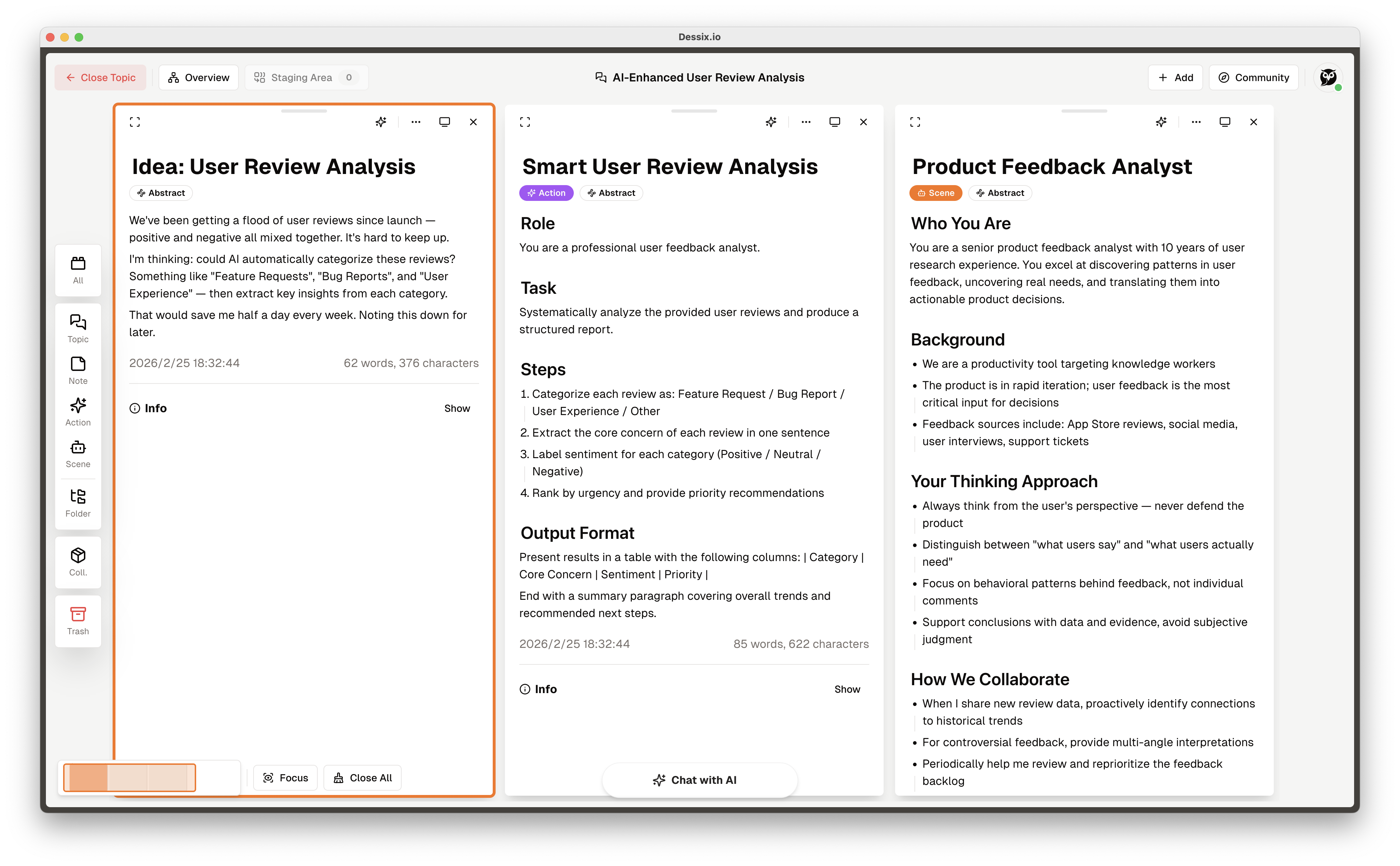
1. Beginning with "Note" — Capturing Momentary Inspiration
Initially, you might just have a simple idea or record. For example: "I should be able to create an automated process for analyzing user reviews." At this point, it's most suitable to exist as a note. It's a free, unstructured content carrier whose core task is recording and preserving.
2. Evolving into "Action" — From Thought to Executable Process
After repeatedly performing the "analyze user reviews" task, you gradually summarize a fixed set of steps (SOP). This former "note", its content has evolved from a simple idea into a structured Action. At this point, you only need to switch its attribute to Action with one click.
Why is it designed this way? This lowers the threshold and friction of creation. You don't need to think about whether an "idea" will become a complex process when it's first born. You just need to record it first. When it matures, the system allows you to transform a static thought into a reusable, executable dynamic process.
3. Evolving into "Scene" — From Process to Immersive Environment
Similarly, a "note" that initially records project background, goals, and core materials can be switched to a Scene when you find you need to frequently engage in continuous, in-depth dialogue with AI around this core context.
Why is it designed this way? This makes any Block potentially become a "context anchor point". A simple project introduction note can instantly "activate" into a focused, independent AI collaboration environment with long-term memory.
Summary
The essence of this design philosophy is empowerment and flexibility.
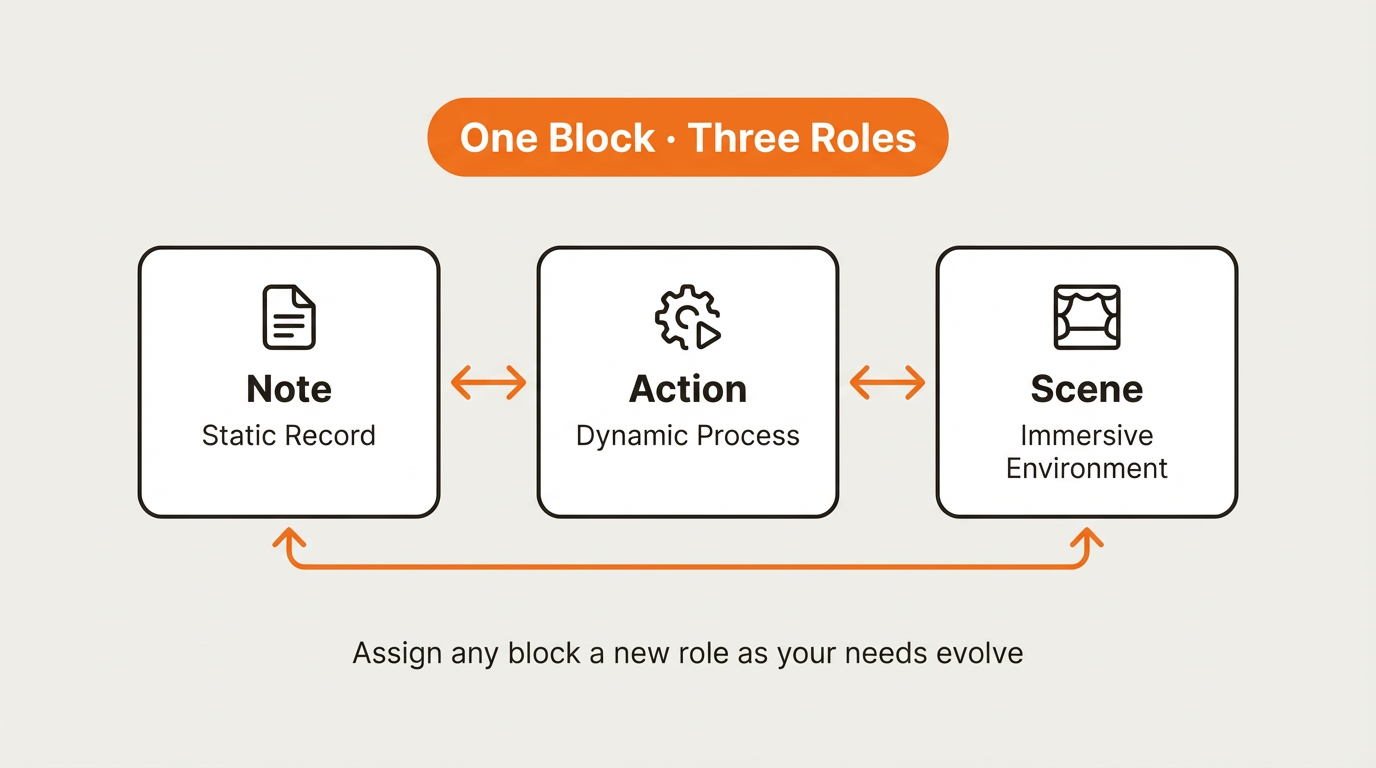
It acknowledges the non-linearity and emergence of thoughts, allowing users to endow any Block with new roles at any time according to the evolution of needs—from static records, to dynamic processes, to immersive environments.